
From the Club to York: How 16 Amateurs Earn a Place at the 2026 UK Championship
By Jibran Khan · 20 October 2026 · News

The UK Championship is one of snooker's three biggest titles, and it finishes at the York Barbican on Sunday 6 December. Mark Selby is the defending champion after beating Judd Trump 10-8 in last year's final. Most of the field is made up of tour professionals, but not all of it. Last week the WPBSA, the sport's governing body, set out how 16 amateur players will earn places in this year's event, and every one of those routes runs through amateur competition.
How the UK Championship field works
The top 16 players in the world rankings once the International Championship has finished are seeded straight into the final stages in York. Everyone else has to qualify. According to the WPBSA, qualifying is played in Leicester from 21 to 26 November, and 16 players come through it to join the seeds in the last 32. The 16 amateurs go into that qualifying draw alongside the professionals.
The four routes in
According to the WPBSA's announcement, the 16 amateur places are split like this:
| Route | Places | How it works |
|---|---|---|
| Q Tour Europe event wins | 3 | The winner of each of the first three Q Tour Europe events of 2026/27 |
| WSF Championships | 3 | Places from the World Snooker Federation championships, including the junior event |
| EBSA European Championships | 3 | Places from the European under-21, under-18 and under-16 championships |
| Q Tour Europe ranking list | 7 | The highest-ranked eligible players on the list after Event 3 |
Some of those places are already filled. Former professional Sanderson Lam won the first Q Tour Europe event of the season, and Malta's Aaron Busuttil won the second, so both are in. The WSF places went to Ryan Davies, Prin Ratmukda and Daniel Boyes, and the EBSA places to Vladislav Gradinari, Krzysztof Czapnik and Riley Powell. The third Q Tour event decides the last winner's place and settles the ranking list for the final seven. If anyone turns their place down, the next player on that ranking list gets it.
Lam's win came at the Northern Snooker Centre in Leeds, where he beat Farakh Ajaib 4-1 in the final. That's worth noticing: a Q Tour event is played in a snooker club, on club tables, and the final was a best of 7, the same length as plenty of club league matches.
Why the ranking list matters most
Seven of the sixteen places come from the ranking list, more than any other route, which means a player doesn't need to win an event to reach York qualifying. Consistent runs to the later rounds can be enough. The list matters beyond the UK Championship too: according to SnookerHQ, the top-ranked player at the end of the Q Tour season earns a two-year professional tour card, and the next 16 eligible players go into the Q Tour Global Play-Offs for another chance at one.
What this means if you play club snooker
For most club players, York is a long way off. But the structure is worth understanding, because it rewards the same things a good club season does: turning up regularly, winning short matches, and keeping a record of results that adds up over time. If your club has a player who dominates the local league, the Q Tour is the next step up, and this year it's a direct line into a Triple Crown qualifying draw.
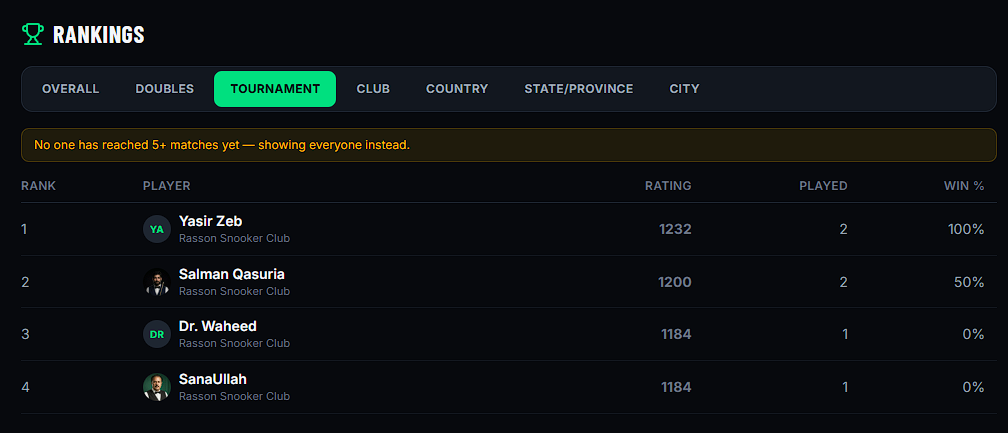
It also helps to know where your own players stand. On the Club plan, SnookerFlow keeps a rating for every player your club scores matches for, and cross-club rankings let you compare them with players at other clubs that use it, from your own club up to your city and country. See the product page for how scoring, the overlay and rankings fit together.
Score your next match with SnookerFlow
Free scoring from any phone, a rules engine that handles free balls, fouls and respots, and a free OBS overlay for your stream.
Create your free account