
10 Snooker Rules Club Players Get Wrong (and What the Rulebook Actually Says)
By Jibran Khan · 16 October 2026 · Guides
Most arguments on a club table aren't about who played better. They're about what the rules actually say, usually at the exact moment nobody has a rulebook to hand. Here are ten rules that come up again and again in club snooker, what people often believe, and what the rulebook really says. The references are to the WPBSA Rules of Snooker, which is what most leagues and clubs play to.
1. Every push shot is a foul
A push shot is when the cue tip stays in contact with the cue ball after it has started moving forward, or as it reaches the object ball. It's a foul. The part people miss is the exception: when the cue ball and the object ball are almost touching, it isn't a push if the cue ball only hits a very fine edge of the object ball. A thin cut off a ball a hair away can be perfectly legal; a full-ball nudge from the same spot isn't.
2. A touching ball doesn't mean you have to hit another ball
When the cue ball comes to rest touching another ball, the referee calls touching ball and you must play away from it without moving it. If you move it, that's a push. But if the ball it's touching is a ball on (say, a red when reds are on), you can play away and there's no penalty for not hitting anything else, because the rules treat the touching ball as already contacted. Club players often insist you still have to hit a red. If it's touching a red, you don't.
3. 'Foul and a miss' isn't automatic, and the third miss only counts with a clear path
A miss is called when the referee decides you didn't make a good enough attempt to hit the ball on, and your opponent can then ask for the balls to be put back and the shot played again. The frame-losing version is narrower than people think. It only applies when you have a clear path to a ball on, and the referee has to warn you first: after a second failure from the same position you're told that the next one gives the frame away. No warning, no awarded frame. If you're snookered, the three-miss rule doesn't apply at all.
4. A free ball isn't a free shot at anything
You only get a free ball after a foul that leaves you snookered, and in the rules 'snookered' has a precise meaning: you can't hit both extreme edges of any ball on in a straight line. Then you nominate another ball and it counts as the ball on, with the ball on's value. Pot a free ball while reds are on and it scores one, like a red, and gets re-spotted. And if you pot the free ball and the ball on together, only the ball on scores, unless the ball on was a red, in which case each ball potted counts.
5. The re-spotted black isn't the last potter's choice
If the scores are level after the last black, the black goes back on its spot and the frame is decided by the next score or foul. The players draw lots (most clubs toss a coin), and the winner chooses who plays first. That player plays from in hand, from the D. Whoever pots the black or fouls first ends the frame. It doesn't matter who potted the last black or whose turn it would otherwise be.
6. In hand means anywhere in the D, including on the line, in any direction
When the cue ball is in hand, you can place it anywhere on or inside the lines of the D. A ball sitting on the line is fine. And once it's placed, you can play it in any direction, including backwards into the baulk cushion, which people sometimes think is banned.
7. Jump shots are fouls, not trick shots
Making the cue ball jump over any part of an object ball is a foul in snooker, however good it looks. There are narrow exceptions in the rule (for instance, if the cue ball has already hit the ball on and then goes over another ball), but you can't deliberately jump a ball in your way to reach the one you want. A snooker has to be escaped around, not over.
8. You need one foot on the floor, not two
It's a foul to strike the cue ball with both feet off the floor. One foot is enough, so stretching across the table on one leg is legal, and so is sitting on the edge of the table, as long as a foot stays down. The rule doesn't apply to players in wheelchairs.
9. The smallest foul is worth four points
A foul on the yellow isn't worth two points, and missing the green isn't worth three. Every foul is worth at least four points to your opponent. It's more when the ball on or a ball involved in the foul is worth more: a foul involving the pink is six, the black seven. The most a single foul can cost is seven, and if several things go wrong on one shot, only the highest penalty counts.
10. After a foul, your opponent can make you play again
When you foul and the cue ball stays on the table, your opponent doesn't have to take the shot you've left. They can ask you to play again from that position. Club players often forget this option exists and gratefully accept a nasty safety, when sending it straight back to the player who fouled was always allowed.
Bonus: where a colour goes when its spot is taken
If a colour needs re-spotting and its own spot is covered, it goes on the highest-value spot that's free, not the nearest one. If every spot is taken, it goes as close as possible to its own spot, on the line between that spot and the top cushion.
Settling it at the table
Most of these arguments get worse when the score is in doubt too. Was that foul four or six? Do they still need snookers? The snooker points calculator answers the second one in a few taps, and it's free with no sign-up.
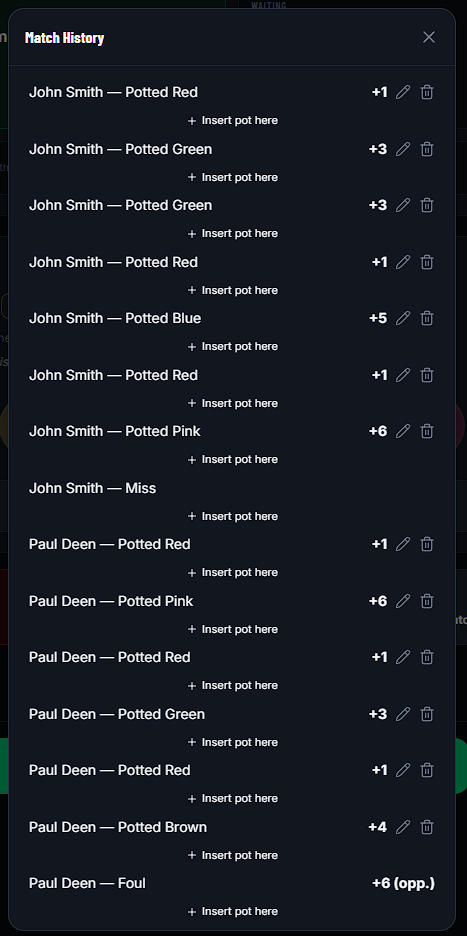
If your club keeps score with SnookerFlow, the referee pad's foul panel lets you pick the foul value and mark a free ball when one applies. If a call changes after a discussion, Match History shows every pot and foul in the frame so you can correct the right one. See The referee pad for how fouls and free balls work on the pad.
Score your next match with SnookerFlow
Free scoring from any phone, a rules engine that handles free balls, fouls and respots, and a free OBS overlay for your stream.
Create your free account