
Champion of Champions 2026 Preview: Who Is in, How They Got There, and the Format
By Jibran Khan · 30 October 2026 · News
The Champion of Champions starts in Leicester on Monday 9 November and finishes on Sunday 15 November. Mark Selby is the defending champion: he beat Judd Trump 10-5 in last year's final. It is a non-ranking invitation event, so there are no ranking points at stake, but the field is small and strong, and the way players earn a place is the most interesting part of the week.
How you get in
There is no qualifying event and no ranking cut-off. Instead, 16 places go to players who won something over the previous year: ranking titles, the Masters, the World Championship, and a handful of other events. When a player wins more than one qualifying event, the spare place is passed further down the list, and the last place goes to the highest-ranked player who has not already qualified.
The field
- Mark Selby: defending champion.
- Wu Yize: world champion.
- Kyren Wilson: Masters champion.
- Zhao Xintong: 2025 Riyadh Season Championship.
- Judd Trump: German Masters.
- Thepchaiya Un-Nooh: World Open.
- Chang Bingyu: Wuhan Open.
- Barry Hawkins: Welsh Open.
- Ali Carter: English Open.
- Chris Wakelin: 2025 Scottish Open.
- Jak Jones: British Open.
- Alfie Burden: 2025 Shoot Out.
- Panchaya Channoi: Women's World Championship.
- Shaun Murphy: World Championship runner-up.
- Ronnie O'Sullivan: World Seniors Championship.
- Neil Robertson: the last place, from the world rankings.
Two of those routes are worth a closer look. Kyren Wilson won the Northern Ireland Open last weekend, but he was already in as Masters champion, and Jak Jones also qualified twice. According to SnookerHQ, those spare places are why the final invitation went down the rankings to Neil Robertson, the world number three. SnookerHQ also reports that the World Seniors Championship was only added to the criteria in September, which is what opened the door for Ronnie O'Sullivan, and that this will be the first appearance in the event for both Chang Bingyu and Panchaya Channoi.
The format
Last year, according to Wikipedia, the 16 players were split into four groups of four. Each group is really a small knockout: two best-of-7 matches, then a best-of-11 group final between the two winners. The four group winners go into best-of-11 semi-finals, and the final is best of 19 over two sessions. We could not find the 2026 frame lengths confirmed yet, but nothing we read suggested a change. The group draw had not been published when we checked.
That opening best-of-7 matters. As we saw at the Northern Ireland Open, first to four is short enough that a quick start from an outsider can send a big name home on day one.
Prize money
The winner takes £150,000 and the runner-up £60,000, from a total prize fund of £440,000. Losing semi-finalists get £30,000 each.
Running your own champions night
The idea behind this event translates well to a club. Invite the winners of your season's competitions, split them into groups of four, and play each group as a tiny knockout. It gives your best players a night of their own, and the group format means everyone gets at least one match against someone in form.
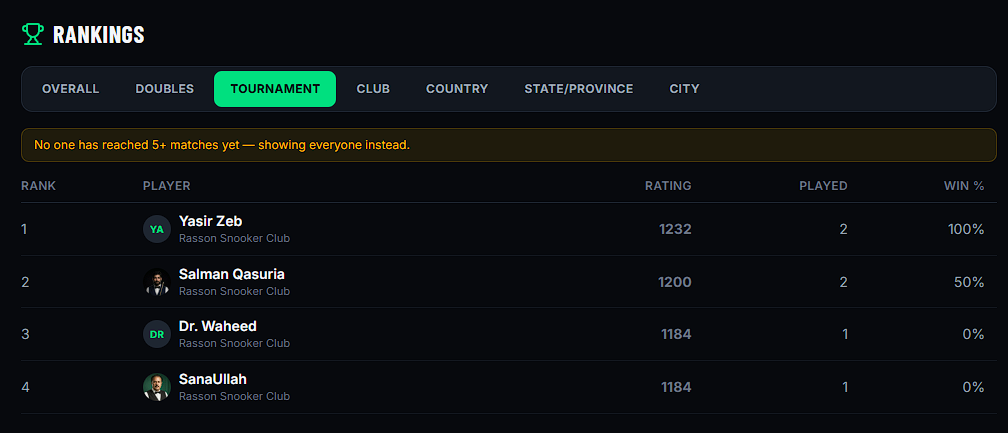
If you want to run it with SnookerFlow, each group of four works as a four-player bracket. The guide to running a tournament shows how to set the best-of length, seed the players and generate the bracket, and matches played inside a tournament also feed a separate tournament-only rating in Rankings. The product page has an overview of the rest, including the live overlay if you want to stream the final.
Score your next match with SnookerFlow
Free scoring from any phone, a rules engine that handles free balls, fouls and respots, and a free OBS overlay for your stream.
Create your free account