
How Many Snookers Do I Need? How to Work It Out at the Table
By Jibran Khan · 3 November 2026 · Guides

Every club player has stood at the table late in a frame, looked at the score and wondered whether it is still worth playing on. The answer is simple arithmetic, but it is easy to get wrong under pressure. This guide shows how to count the points remaining, how to tell when you need snookers, and how to work out how many, with the same maths our free snooker points calculator uses to show snookers required.
Step 1: count the points left on the table
A red is worth 1 and the colours run from yellow (2) up through green (3), brown (4), blue (5) and pink (6) to black (7). The most anyone can score from a position assumes the best case: every remaining red followed by the black, then all six colours in order.
- Each red left is worth up to 8 points: 1 for the red and 7 for the black after it.
- The six colours at the end add up to 27 (2 + 3 + 4 + 5 + 6 + 7).
- So with reds on the table, points remaining = reds left × 8 + 27.
- With all 15 reds still there, that is 15 × 8 + 27 = 147, the maximum break.
- If a red has just been potted and you are on a colour, add 7 for that colour first.
Once the reds are gone, only count the colours still on the table. On the yellow there are 27 left, on the green 25, the brown 22, the blue 18, the pink 13, and just 7 when only the black remains.
Step 2: compare the gap with the points remaining
Now take the difference between the two scores. There are three outcomes:
- The gap is smaller than the points remaining: you can still win by potting, without needing your opponent to foul.
- The gap is exactly the points remaining: potting everything only ties the frame, and a tied frame is decided by a re-spotted black.
- The gap is bigger than the points remaining: you need snookers. Potting alone can no longer catch up, so you need your opponent to give away points through fouls.
Step 3: work out how many snookers
A foul gives the other player at least 4 points, and more when the ball on (or a ball involved in the foul) is worth more, up to 7 for the black. To count snookers, take the shortfall (the gap minus the points remaining), divide it by the value of a foul, and round up. If the shortfall divides exactly, the last snooker only levels the scores, and you would be playing for a re-spotted black.
This counts the fouls you need, not the shots it takes to lay them. A snooker only pays out if your opponent actually fouls, and the count assumes they score nothing else in the meantime. It is a guide to whether the frame is still alive, not a promise.
Worked examples
- Six reds left, you trail 60-20. Points remaining are 6 × 8 + 27 = 75 and the gap is 40, so you can still win by potting, but you need at least 41 of those 75.
- Two reds left, you trail 70-20. Points remaining are 2 × 8 + 27 = 43 and the gap is 50. The shortfall is 7, and at 4 points a foul that rounds up to 2 snookers.
- On the pink, you trail 55-35. Pink and black are worth 13 and the gap is 20, so the shortfall is 7. A foul on the pink is worth 6, so you still need 2 snookers: one gets you to within 14, which is still more than 13.
- Only the black left, you trail by 7. Potting it ties the frame, so you play on for a re-spotted black. Trail by 8 and you need one snooker on the black, which is worth 7 and puts you within reach.
Why the colours change the maths
While reds remain, a foul is usually worth 4, so each snooker only claws back 4 points. Once you are on the colours, the foul value follows the ball on: 5 on the blue, 6 on the pink, 7 on the black. That is why a frame that looked dead with reds on the table can come back late on. The points remaining shrink with each colour, but each snooker is worth more. It also works the other way: if you lead, every safety shot on the final colours carries a bigger penalty if you get it wrong.
Common mistakes
- Counting 7 per red instead of 8. The red itself is worth a point too.
- Forgetting the colour you are already on after potting a red.
- Assuming every foul is worth 4 on the colours. On the pink or black it is 6 or 7.
- Ignoring a free ball. When you are snookered after a foul, a free ball can let you score more than the normal count, so the numbers above are the usual case, not every case.
Use a snooker points calculator to check
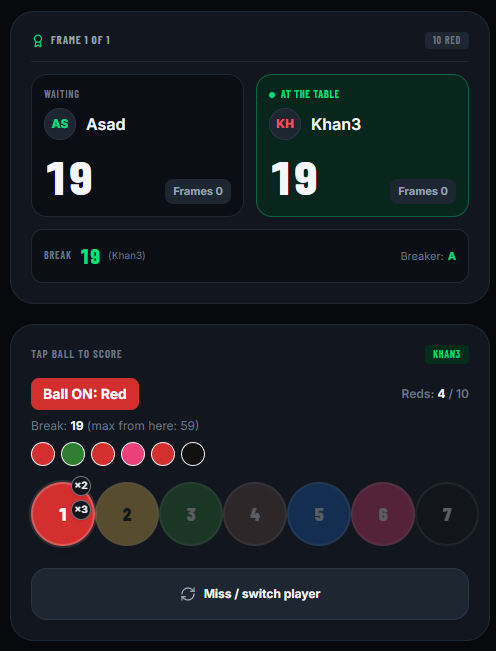
If you would rather not do the sums at the table, the free snooker points calculator takes the two scores, the reds left and the ball on, and tells you whether the player behind can still win and how many snookers are required. It runs on the same rules engine as the SnookerFlow referee pad, which keeps the score as you play and tracks the reds remaining, so the numbers on your phone and the numbers in this guide always agree.
Score your next match with SnookerFlow
Free scoring from any phone, a rules engine that handles free balls, fouls and respots, and a free OBS overlay for your stream.
Create your free account