
Northern Ireland Open 2026 Preview: Dates, Format, and Why Best-of-7 Makes Belfast So Unpredictable
By Jibran Khan · 13 October 2026 · News
The Northern Ireland Open starts on Sunday 18 October at the Waterfront Hall in Belfast and runs to the final on Sunday 25 October. It's the second of the season's four Home Nations events, after the English Open, and the winner takes home £100,000 and the Alex Higgins Trophy (the runner-up gets £45,000). The qualifying rounds were played in Leicester in September, so the 64 players who arrive in Belfast are already through to the main draw.
The format: best of 7 until the quarter-finals
Every match from the last 64 through to the last 16 is best of 7 frames. The quarter-finals step up to best of 9, the semi-finals to best of 11, and the final is best of 17 over two sessions. That means a player has to win three short matches in a row just to reach the last eight, and that's where Home Nations events earn their reputation for upsets.
| Round | Format |
|---|---|
| Last 64 | Best of 7 |
| Last 32 | Best of 7 |
| Last 16 | Best of 7 |
| Quarter-finals | Best of 9 |
| Semi-finals | Best of 11 |
| Final | Best of 17, over two sessions |
Why best of 7 is so hard to call
In a best-of-7, the first to four frames wins, and one frame can swing the whole match. A single century, a missed black off the spot, or a safety battle that goes the wrong way on the last red is enough. In a best-of-19 the better player usually has time to recover from a bad session; in a best-of-7 there is no second session. Lose the first two frames and you need four of the next five against someone who is playing well enough to have just won two.
That's also why best of 7 is the format most club leagues and club knockouts use. It fits an evening, it keeps a bracket moving, and it gives the lower seed a genuine chance. If you've ever watched a club favourite go out 4-2 to someone they beat every week, you've seen the same thing the Home Nations produce on television.
First-round matches worth watching
Defending champion Jack Lisowski opens the tournament against Huang Jiahao. Lisowski won this event last year by beating Judd Trump 9-8 in the final, the first ranking title of his career after six losing ranking finals, so he arrives in Belfast with ranking points from that run to defend. World champion Wu Yize plays Scott Donaldson. Other ties that stand out on paper:
- Stephen Maguire v Anthony McGill: an all-Scottish match between two players who know each other's game well.
- Neil Robertson v Ricky Walden: two former ranking event winners meeting on the opening days.
- Ronnie O'Sullivan v Cheung Ka Wai, Judd Trump v Martin O'Donnell and Mark Selby v Louis Heathcote: the big names, each one bad frame away from an early flight home in a best-of-7.
- Hossein Vafaei v Matthew Selt: two attacking players who can both end a frame in one visit.
The race for a UK Championship seeding
Belfast matters for more than its own trophy. The top 16 in the rankings go straight into the UK Championship in York later in the autumn, and everyone else has to come through qualifying. According to SnookerHQ's provisional list (as of 7 October), the Northern Ireland Open and the International Championship are the last two events that count, and the gap at the cut-off is tiny: Zhou Yuelong held 16th place just £3,500 ahead of Chang Bingyu in 17th, with Lisowski, Stuart Bingham and Zhang Anda close behind. A run to the quarter-finals in Belfast could decide who gets the automatic place.
Running your own best-of-7 knockout
If a week of Home Nations snooker gets your club in the mood for its own knockout, best of 7 is a good place to start: long enough that the better player usually wins, short enough to get through a round in a night. Seed the draw, pick a frame limit everyone agrees on before the first break, and decide in advance what happens if a match runs past closing time.
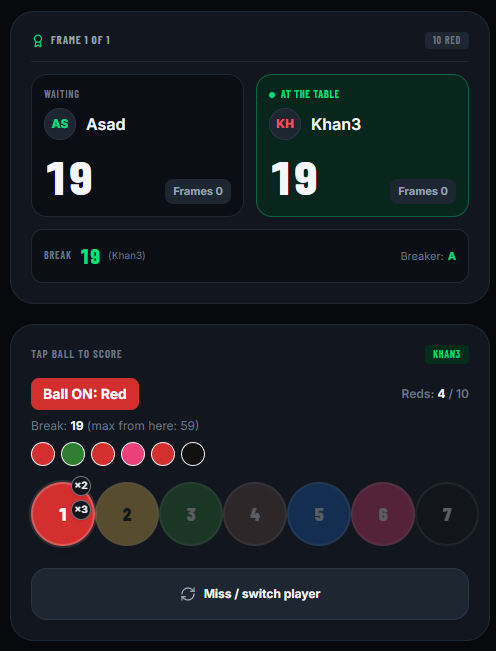
SnookerFlow handles the bookkeeping for you. Create a tournament with a best-of length and a seeding method, generate the bracket, and each match opens a referee pad when you press Start; when it finishes, the winner moves into the next round automatically. Every tournament also gets a public bracket page you can share with players or put on the club TV. See Running a tournament for the steps, or pricing for which plan includes tournaments.
Score your next match with SnookerFlow
Free scoring from any phone, a rules engine that handles free balls, fouls and respots, and a free OBS overlay for your stream.
Create your free account