
Cross-Club Rankings Explained: One Player, One Rating, Every Club
By Jibran Khan · 3 September 2026 · Updates

A club ladder has always had one blind spot: it only knows about matches played inside that one club. A player who's genuinely one of the best in their city could be near the top of two separate club ladders and never see a single ranking that reflects it, because no club's database has ever known those two rows of players were the same person. Rankings fixes that - one linked identity, seven ranking tiers, all reading from the same shared rating.
Why club ladders stop at the door
Every club runs its own roster - its own player rows, its own match history, its own rating. That's the right default for privacy and ownership, but it means a player who turns up at two clubs in the same town ends up as two unrelated records, each with half their real form. Neither club's ladder is wrong, exactly - it's just answering a narrower question than "how good is this player, really," because it can only see its own half of the picture.
Linking one player across clubs
The fix starts before any ranking is shown: when setting up a match, searching a player's name surfaces matches from every club on the platform, not just your own roster. Recognize a genuine cross-club opponent and one click links them to a shared global identity - their rating and match totals from that point on are tracked once, centrally, and blended in from every club they play at. Nothing about either club's own roster or ownership changes; only the rating calculation now sees the full picture. A link can be undone from Player Management at any time, cleanly, with no trace left on either side.
The seven ranking tiers
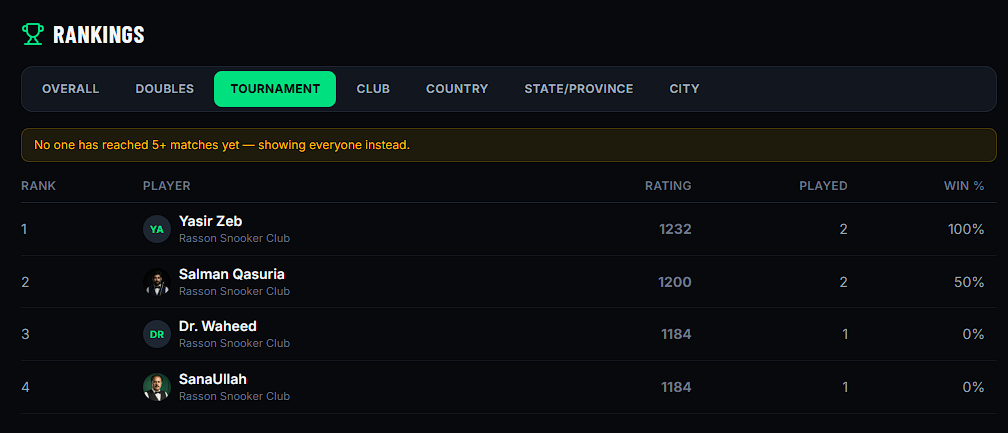
Once identities are linked, Rankings splits into two families of tiers, because "best overall" and "best in this tournament" are genuinely different questions with different ratings behind them.
| Tier | Question it answers | Rating used |
|---|---|---|
| Overall | Best players platform-wide, singles | Blended rating (every match, every club) |
| Club | Best players at one specific club | Blended rating, filtered to that club |
| Doubles | Best doubles pairings platform-wide | Blended doubles rating |
| Tournament | Best players in competitive tournament play | Tournament-only rating |
| Country | Best tournament players in a country | Tournament-only rating, filtered by club location |
| State/Province | Best tournament players in a state or province | Tournament-only rating, filtered by club location |
| City | Best tournament players in a city | Tournament-only rating, filtered by club location |
Blended rating vs. tournament-only rating
Overall, Club, and Doubles read from a single blended rating that moves on every match a player plays - a casual frame at their home club counts exactly the same as a tournament knockout. Tournament, Country, State/Province, and City deliberately read from a second, completely separate rating that only moves on matches actually played inside a tournament. That split matters for anyone weighing up a result: a strong Overall rating says "plays a lot and wins," while a strong Tournament rating says "wins when it's actually on the line" - and a player can rank very differently on the two without either number being wrong.
Where to find it
Rankings lives at its own page, gated at the Club plan since it's built on the same identity infrastructure as cross-club player search. Linking a player takes one click during match setup the first time a real cross-club opponent shows up in search - everything after that, the rating math and the ranking tables, happens on its own. See Cross-club Rankings in the docs for the full walkthrough, or Running a tournament for how tournament-only ratings get their own separate track in the first place.