
Snooker's Shot Clock Debate Is Real Again. Here's What 15 Seconds Actually Does to a Frame
By Jibran Khan · 3 September 2026 · News
The shot clock argument in snooker has a familiar shape. A frame runs long, someone calls it unwatchable, a player says the game has to modernise, a traditionalist says it's fine as it is, and everyone moves on until the next time. Except this time the governing body's own chairman has joined in.
WPBSA chairman Jason Ferguson has said publicly, for what reporting on his appearance on Stephen Hendry's show Cue Tips describes as the first time, that he's open to examining shot times: "I think we've always got to be open-minded about change. One thing I'd like to see is perhaps a more open look at shot times." It's a governing-body chairman engaging with an idea the tour has resisted for years, not an announcement of a new rule - but it's a real shift in tone, and it followed a specific, public push.
Shaun Murphy has been arguing for a shot clock for two decades, and he renewed the case loudly last December, working as a BBC commentator during the UK Championship, after what he described as deliberate slow play from Mark Allen in a semi-final against Barry Hawkins. "I'd bring in a shot clock," Murphy said. "I've been saying this for 20 years, so I'm super-consistent on this." Nothing is confirmed - a full rollout across ranking events looks unlikely, and the game's flagship tournaments would be the last places it reached even if trials happened elsewhere. But the conversation itself has moved.
What's largely missing from the coverage is anyone describing what a clock actually does to a frame, shot by shot. We can describe it, because we build the clocks.
Snooker already has shot clocks. Two of them.
The debate is usually framed as though a clock would be a new invention. It wouldn't. Snooker has run timed formats for years, and they behave in measurably different ways.
The Shoot-Out uses a ten-minute frame with a clock that changes speed halfway through: 15 seconds per shot for the first five minutes, then 10 seconds for the second five. That mid-frame switch is the single most interesting piece of rule design in modern snooker, and we'll come back to it. Snooker 900 takes a different approach - a fixed 900-second frame with a flat 20 seconds per shot throughout, no acceleration, no phase change. Longer frame, gentler clock.
So when people ask whether a shot clock would work in snooker, the honest answer is that we already know it works. The real question is what it costs.
The first thing to die is safety play
Put a 15-second clock on a frame and the first casualty isn't break-building, it's the safety exchange. A good safety shot in open play is a planning problem - walk the table, look at it from a few angles, work out where the cue ball finishes as well as where it starts. That process takes forty seconds to a minute and a half, and it's genuinely most of what elite safety play is.
Fifteen seconds is enough to see one option and hit it. Players stop playing the safety they want and start playing the safety they can see immediately - usually thinner, looser, more likely to leave something. The frame opens up and more balls get potted. Whether that's an improvement depends entirely on whether you think snooker's problem is that it's too slow or too shallow. A clock doesn't just speed the game up; it changes which skills get rewarded.
Break-building survives better than you would expect
The counterintuitive part is that a player mid-break barely notices a 15-second clock. Once you're among the balls with a clear pattern, most shots are decided before the previous one has finished rolling - watch any Shoot-Out and you'll see 60-plus breaks made without the clock coming close to expiring. Where it bites is the shot into the break, the awkward opening red that needs a decision about which side of the pack to enter from. That's a thinking shot, and thinking shots are what a clock taxes.
The part nobody in the debate mentions: someone has to run it
Every article about shot clocks discusses whether players should have one. Almost none discuss who operates it. In a televised Shoot-Out there's a production team and a graphics system - the referee referees, somebody else counts. That infrastructure is a large part of why timed formats exist at ranking events and essentially nowhere else.
Drop the same rule into a club on a Tuesday night and you have one person trying to referee the frame, watch for touching balls, judge a possible miss, keep the score, and run a countdown with a phone in their other hand. It doesn't work by hand. That's the actual reason timed formats haven't spread into the amateur game - not resistance to the idea, but the absence of anyone free to press the buttons.
Clubs don't have to wait for a rulebook
Here's the part that gets lost in a tour-level debate. The professional game needs a governing-body decision, player consultation, and a broadcast contract before anything changes. A club needs none of that. If you want to run a timed competition on your own table next month, you can - and a four-hour club night on one table is a much more pressing problem than a long session at the Crucible. If eight people have turned up and there's one table, a ten-minute frame isn't a gimmick. It's the difference between everyone playing and half of them going home early.
How SnookerFlow handles it
SnookerFlow runs both clocks properly. The Shoot-Out clock does the 15-to-10-second switch automatically at the five-minute mark, so the referee never has to watch for it mid-frame - it's free on every plan, including the free tier. Snooker 900's flat 20-second clock is on Pro. Either way, the countdown appears on the referee's phone and the stream overlay at the same time, so players, spectators, and viewers are all looking at the same number, which removes most of the arguments before they start.
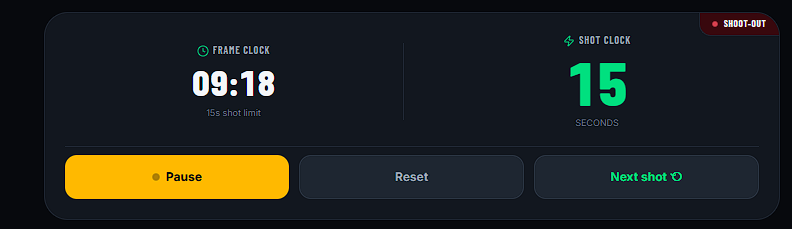
See Choosing a match format in the docs for how to pick a timed format, or the overlay showcase for what the live countdown looks like on stream.