Snooker Has No 'Deliberate Foul' Rule. Two Incidents This Season Show Why That Matters at Club Level
By Jibran Khan · 7 September 2026 · News

"Deliberate foul" has been trending in snooker forums for weeks, and there's no rule with that name to point to. Two incidents this season have put that gap on display - and it's actually a bigger problem for a club referee than for a professional one.
The shot that split the room
At the 2026 China Open in Taiyuan, Stuart Bingham led Hossein Vafaei 4-0 in frames and 60-8 in points during frame five of their last-16 match. Needing to escape a tough position - cue ball tight on the baulk cushion, one red reachable near a middle pocket - Vafaei played thin off that red and sent the cue ball in-off. Bingham confronted him on the spot, accusing him of going in-off on purpose to get out of trouble rather than trying to play a genuine safety. Vafaei said afterwards he'd been trying to bring the cue ball back to a safe area. No rule had been broken, so play continued, and Bingham later posted a reaction on social media captioned "not in the spirit of the game."
It wasn't the only one
A few weeks earlier at British Open qualifying, Oliver Lines was frustrated when opponent Xu Yichen appeared to pot the brown by first striking the yellow ball on - which happened to be sitting right against it, dangling over the same pocket. Nothing illegal happened there either. Two incidents, two different players, the same shape: a shot that's legal by the letter of the rules but reads, to the opponent and to a lot of people watching, as gaming the position rather than playing it.
What the rulebook actually says
There is no "deliberate foul" in the WPBSA rulebook. What exists instead is a general conduct clause that lets a referee act against play they judge to be wilfully or persistently unfair - a much higher, much vaguer bar than "I don't like that shot selection." Former World Championship final referee Leo Scullion has said it would take a very strong referee to actually stand up and call a shot out under that clause in the moment, and that the rest of it runs on an unwritten code among players that, by his own account, doesn't always get honoured.
Why that's harder at club level, not easier
It's tempting to read this as a pro-game curiosity - two players who've faced each other on television, a rule technically satisfied, a debate for pundits. But a professional referee at least has a crowd, a broadcast, and a governing body behind that conduct clause if they ever need to lean on it. A club referee reffing a Tuesday-night frame has none of that. If a similar shot happens at your table, it's just you, in the moment, deciding whether to say something - with no replay, no second opinion, and a room full of people who saw it happen live and will remember it differently by the time you're asked about it later.
The practical answer isn't a rule you can adopt locally - the professional game hasn't found one either. It's making sure that whatever you decide in the moment, the facts of what actually happened aren't also up for debate afterward.
How SnookerFlow handles it
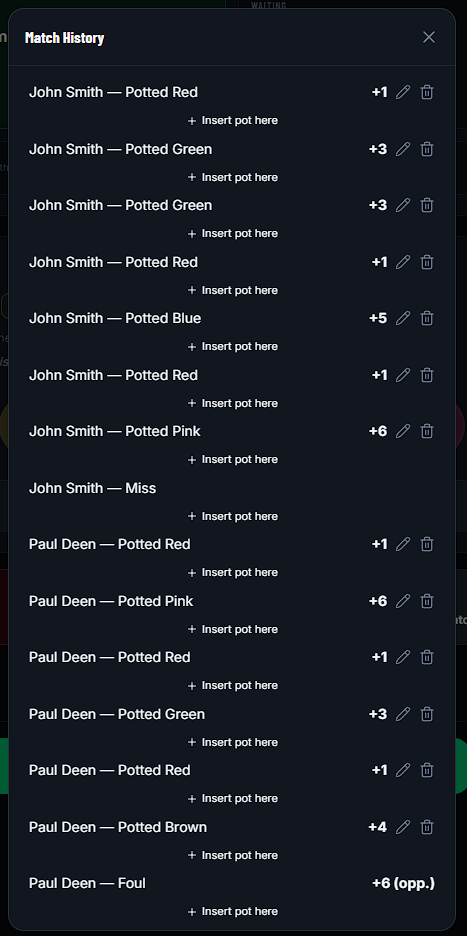
SnookerFlow doesn't referee conduct - no software should try to guess whether a shot was genuine. What it does do is keep an exact, shot-by-shot record of the frame as it happens: every pot and every foul, in order, reviewable from the referee pad at any point. It won't tell you whether a shot was deliberate. But if a call gets argued about after the fact, you're arguing from a record instead of from memory. See Correcting a mistake with Match History for how the log works, or Pricing for what's included on the free tier - Match History is on every plan.