
Judd Trump's 12-Minute British Open Delay Shows Snooker's Weakest Rule Is Also Its Most Common One
By Jibran Khan · 14 September 2026 · News
Judd Trump won his British Open last-16 match 4-2 last week. Almost nobody who watched it will remember a shot from it. What they'll remember is the 12 minutes in the middle where nobody played one at all.
The delay
At the British Open in Cheltenham, Judd Trump's last-16 tie with Dylan Emery ground to a halt when Emery played two safety shots in a row around a packed cluster of reds, and both attempts disturbed the pink sitting nearby. Referee Proletina Velichkova and marker Terry Camilleri then spent upwards of 12 minutes trying to work out exactly where the pink - and the reds it had brushed against - had been before either shot was played, so they could put everything back. Trump eventually won the frame and the match, then used his post-match interview to say what a lot of players have said quietly for years: the sport has no consistent way to solve this problem, and it should.
His proposed fix was specific. Chinese snooker venues increasingly use an overhead camera system that projects a circle showing exactly where each ball should sit, then flashes when it's back in the right spot. "I have no idea why they don't use it here," Trump said, adding that he's played under the same system in Hong Kong, where it also tracks the score. It's a reasonable ask for a televised ranking event with a rigging budget. It's also a complete non-starter for the room this problem actually shows up in most often.
What the rule actually says
Snooker's rule for a disturbed ball is short, and it hands the entire decision to one person's eyes. If a ball is disturbed by anything other than the striker's own legal shot - another ball drifting into it, a sleeve catching it, a marker's hand - the referee repositions it to where they judge it was, or would have finished, with no penalty attached to the disturbance itself. That's the whole rule. There's no tolerance stated in millimetres, no reference photo required, no second opinion built in. "Judges" is doing all the work in that sentence, and it always has been.
That's fine when one ball rolls two inches into open space - anyone can eyeball that back correctly. It stops being fine the moment the disturbed ball was touching, or nearly touching, several others in a tight cluster, because now restoring it correctly means also being sure none of its neighbours moved with it. That's exactly the shape of the Trump-Emery delay: a pack of reds, a pink close enough to be at risk twice, and a referee reconstructing a three-dimensional arrangement from memory under a clock that, in a ranking event, is at least a shot clock rather than an actual stopwatch on the stoppage itself.
Why a club referee has it worse, not better
It's tempting to read a 12-minute professional stoppage as the extreme case and assume a club game is simpler. It isn't - it's the same rule with every advantage the professional version has stripped away. A televised match has a second official on the table, multiple broadcast camera angles anyone can rewind, and a crowd of people who saw the shot from different seats. A club referee reffing alone on a Tuesday night has none of that. If a break in a tight pack gets knocked while you're rerailing after a foul, or a spectator's bag brushes a cushion ball, you are the entire replay system, working from whatever you happened to notice a few seconds earlier.
Trump's camera system was never going to reach a club table, and it doesn't need to. The actual gap it's covering - a reliable record of where a cluster was before it got disturbed - has a version that already fits in every referee's pocket. Before playing or refereeing around a genuinely tight pack, a two-second phone photo of the cluster costs nothing and needs no setup. It's not going to happen on every shot, and it shouldn't; most safety exchanges never go near enough balls to need it. But the ten or so shots a frame where a bad angle or a heavy contact could scatter a pack are exactly the moments worth the two seconds, and exactly the moments a memory alone is weakest.
How SnookerFlow handles it
Nothing about a scoring app can put a ball back on its spot - that part is still entirely down to the referee's own eyes, or a photo taken the moment before. What SnookerFlow can do is make sure a long stoppage never turns into a second argument about the score on top of the first one about the table. The referee pad keeps the score, the reds remaining, whose visit it is, and the ball on locked and visible throughout - a 12-minute pause to sort out a cluster doesn't put any of that in doubt, and anyone watching the overlay sees the same numbers the whole way through. Restoring the table is still on you. Restoring the frame's own state isn't.
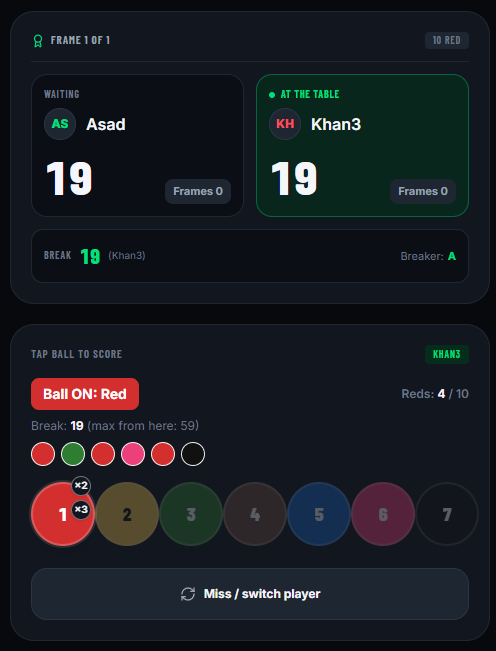
See The referee pad in the docs for how the live state tracking works, or the overlay showcase for what stays on screen during a stoppage like this one.